 |
posix-next API 0.1.0
Out-of-tree Zephyr POSIX module
|
|
posix-next API 0.1.0
Out-of-tree Zephyr POSIX module
|
POSIX asynchronous I/O (<aio.h>) More...
#include <stddef.h>#include <stdint.h>#include <signal.h>#include <zephyr/toolchain.h>#include <time.h>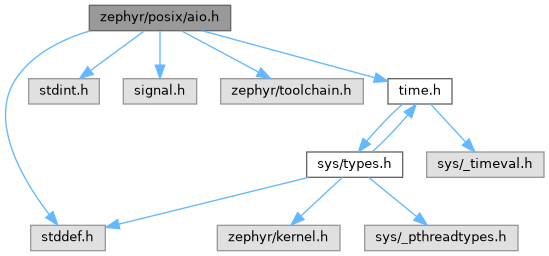
Go to the source code of this file.
Data Structures | |
| struct | timespec |
| Time value with nanosecond resolution. More... | |
| struct | aiocb |
| Asynchronous I/O control block. More... | |
Macros | |
| #define | __SIZE_TYPE__ unsigned long |
| #define | unsigned signed /* parasoft-suppress MISRAC2012-RULE_20_4-a MISRAC2012-RULE_20_4-b */ |
| #define | AIO_ALLDONE 2 |
| All requested operations have already completed. | |
| #define | AIO_CANCELED 0 |
| All requested operations were canceled. | |
| #define | AIO_NOTCANCELED 1 |
| Some of the requested operations could not be canceled. | |
| #define | LIO_NOP 2 |
| lio_listio() list element: no transfer is requested. | |
| #define | LIO_NOWAIT 1 |
| lio_listio() mode: return once the operations are queued. | |
| #define | LIO_READ 0 |
| lio_listio() list element: request a read. | |
| #define | LIO_WAIT 0 |
| lio_listio() mode: wait until all operations are complete. | |
| #define | LIO_WRITE 1 |
| lio_listio() list element: request a write. | |
Typedefs | |
| typedef long | off_t |
| typedef signed long | ssize_t |
Functions | |
| int | aio_cancel (int fildes, struct aiocb *aiocbp) |
| Cancel an outstanding asynchronous I/O request. | |
| int | aio_error (const struct aiocb *aiocbp) |
| Retrieve the error status of an asynchronous I/O request. | |
| int | aio_fsync (int op, struct aiocb *aiocbp) |
| Asynchronously synchronise a file's data and metadata to storage. | |
| int | aio_read (struct aiocb *aiocbp) |
| Enqueue an asynchronous read operation. | |
| ssize_t | aio_return (struct aiocb *aiocbp) |
| Retrieve the return status of a completed asynchronous I/O request. | |
| int | aio_suspend (const struct aiocb *const list[], int nent, const struct timespec *timeout) |
| Wait for one or more asynchronous I/O requests to complete. | |
| int | aio_write (struct aiocb *aiocbp) |
| Enqueue an asynchronous write operation. | |
| int | lio_listio (int mode, struct aiocb *const list[ZRESTRICT], int nent, struct sigevent *ZRESTRICT sig) |
| Initiate a list of asynchronous I/O requests. | |
POSIX asynchronous I/O (<aio.h>)
Provides the aiocb control block and the asynchronous I/O functions. Operations are submitted to the OS-managed request pool (CONFIG_SYS_AIO) and performed by a dedicated kernel service queue; completion is observed with aio_error(), aio_suspend(), and aio_return(), or announced by the control block's sigevent.
Definition in file aio.h.
| #define AIO_ALLDONE 2 |
| #define AIO_NOTCANCELED 1 |
| #define LIO_NOP 2 |
lio_listio() list element: no transfer is requested.
| #define LIO_NOWAIT 1 |
lio_listio() mode: return once the operations are queued.
| #define LIO_READ 0 |
lio_listio() list element: request a read.
| #define LIO_WAIT 0 |
lio_listio() mode: wait until all operations are complete.
| #define LIO_WRITE 1 |
lio_listio() list element: request a write.
| #define unsigned signed /* parasoft-suppress MISRAC2012-RULE_20_4-a MISRAC2012-RULE_20_4-b */ |
 1.9.8
1.9.8