 |
posix-next API 0.1.0
Out-of-tree Zephyr POSIX module
|
|
posix-next API 0.1.0
Out-of-tree Zephyr POSIX module
|
POSIX select API (<sys/select.h>) More...
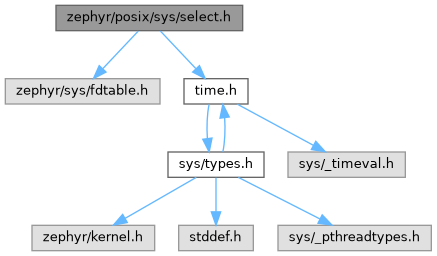
Go to the source code of this file.
Data Structures | |
| struct | sigset_t |
| Set of signals (bitmask). More... | |
| struct | timespec |
| Time value with nanosecond resolution. More... | |
| struct | timeval |
| Time value with microsecond resolution. More... | |
Macros | |
| #define | FD_SETSIZE ZVFS_FD_SETSIZE |
| Maximum number of file descriptors in an fd_set. | |
| #define | SIGRTMIN (CONFIG_THREAD_CANCEL_SIGNAL_NUMBER + 2) |
| #define | SIGRTMAX SIGRTMIN |
Typedefs | |
| typedef long | suseconds_t |
| Microsecond time component type. | |
| typedef struct zvfs_fd_set | fd_set |
| Set of file descriptors for select()/pselect(). | |
Functions | |
| int | pselect (int nfds, fd_set *readfds, fd_set *writefds, fd_set *exceptfds, const struct timespec *timeout, const sigset_t *sigmask) |
| Synchronous multiplexed I/O with signal-mask and nanosecond timeout. | |
| int | select (int nfds, fd_set *readfds, fd_set *writefds, fd_set *errorfds, struct timeval *timeout) |
| Synchronous multiplexed I/O (legacy interface, use pselect() for new code). | |
| void | FD_CLR (int fd, fd_set *fdset) |
| Remove a file descriptor from an fd_set. | |
| int | FD_ISSET (int fd, fd_set *fdset) |
| Test whether a file descriptor is in an fd_set. | |
| void | FD_SET (int fd, fd_set *fdset) |
| Add a file descriptor to an fd_set. | |
| void | FD_ZERO (fd_set *fdset) |
| Clear all file descriptors from an fd_set. | |
POSIX select API (<sys/select.h>)
Provides the select() and pselect() functions and the associated fd_set type and macros for multiplexed I/O.
Definition in file select.h.
 1.9.8
1.9.8